- Welcome to Webmaster Forums - Website and SEO Help.

Webmaster Tools and Website Help Forums





Recent posts
#1
Website, Webmaster, Marketing and SEO Tools / Re: [GEEKPROXY.IO] - DC | ISP ...
Last post by geekproxy - October 22, 2026, 09:58:57 PM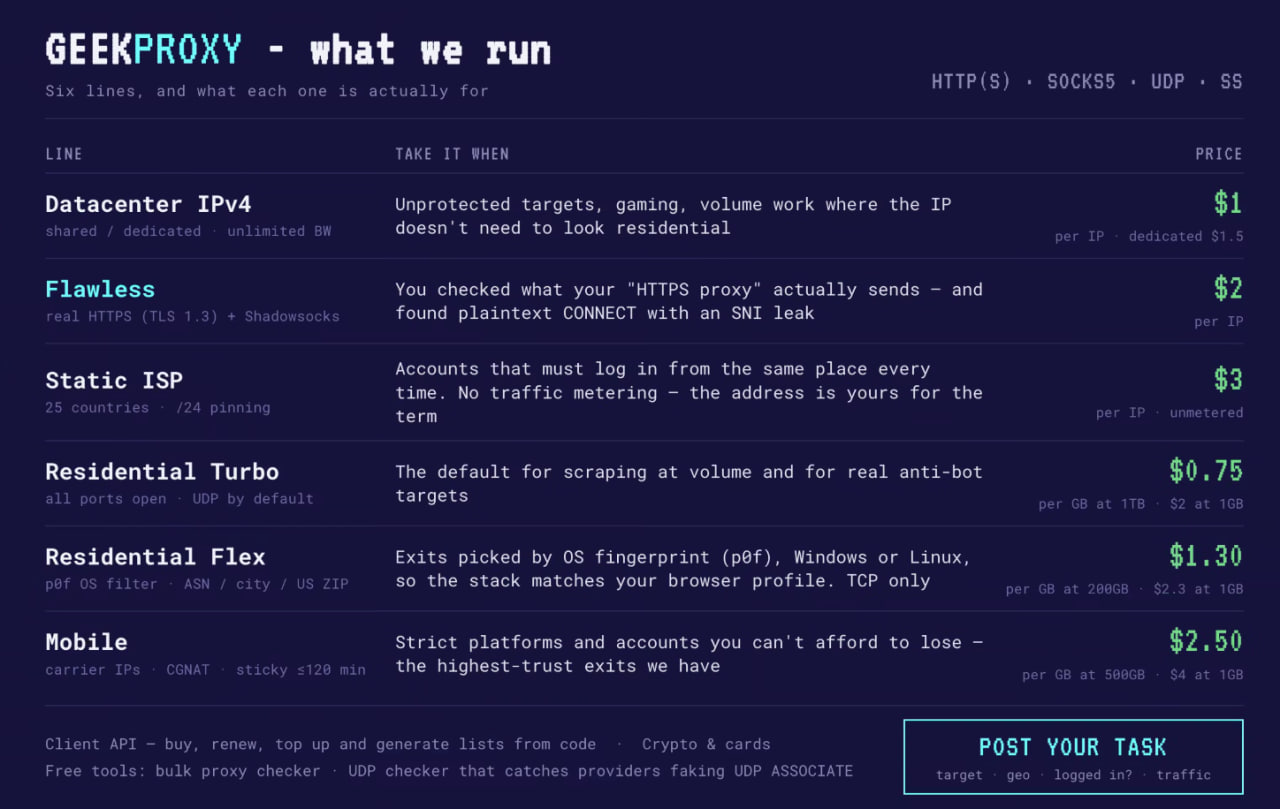
Datacenter IPv4 - fast and cheap, unlimited bandwidth, billed per IP. Scraping unprotected targets, gaming, volume work where the IP doesn't need to look residential. Shared $1/IP, dedicated $1.5/IP. Locations: US, DE, NL, RU, FI, UA, EU-mix.
Flawless (datacenter+) - same hardware, plus real HTTPS to the proxy (TLS 1.3, valid cert, no SNI leak on the first hop) and Shadowsocks. For anyone who checked what their "HTTPS proxy" actually sends. $2/IP.
Static ISP - the address is registered to a real ISP and stays yours for the whole term, no traffic metering. Accounts that must always log in from the same place, ad verification, long sessions. 20+ countries, US city targeting and /24 pinning. From $3/IP.
Residential Turbo - all ports open, UDP on by default, free country selection. The default for scraping at volume and for real anti-bot. 1GB $2 → 1TB $0.75/GB.
Residential Flex - precise targeting: state, city, ZIP, ASN, OS fingerprint (p0f windows, linux, macos)
Mobile - real carrier IPs behind CGNAT, the highest-trust exits we have. Strict platforms and accounts you can't afford to lose. 1GB $4 → 500GB $2.50/GB, sticky up to 120 min.
Across all of them: HTTP(S), SOCKS5, UDP, Shadowsocks. Client API for buying, renewing, topping up and generating lists from code. Crypto and cards.
Free tools if you just want to check something: bulk proxy checker and a UDP checker that catches providers faking UDP ASSOCIATE.
Test packages still go out for an honest review.
Main post: MAIN
Website: https://geekproxy.io/
#2
Website, Webmaster, Marketing and SEO Tools / Re: [GEEKPROXY.IO] - DC | ISP ...
Last post by geekproxy - October 10, 2026, 11:54:49 AM
Residential Flex now matches the exit's OS fingerprint (p0f)
Most residential pools are mostly Linux-based devices: phones, routers,TV boxes. A Windows browser profile that goes out through such an exit shows a Windows user-agent on top of a Linux TCP stack, and that mismatch is exactly what passive fingerprinting (p0f and the engines built on the same idea) is designed to catch. The rebuilt Residential Flex lets you choose the exit by its OS fingerprint: Windows machines, or Linux-based devices (Android, macOS, Linux).
How you use it: one option in the login, os-windows or os-android, on top of any geo. Windows exits are a part of the pool and the share varies by country, so expect fewer exits with the filter on.
Everything else that changed in Flex
- Targeting: country, state or region, city, ISP (ASN) and US ZIP code. City is exact for large metro areas, US ZIP is exact where inventory exists; outside the US a postal code narrows to the city.
- Fallback mode. By default a target with no live exit fails instead of handing you an address somewhere else; the country is never swapped. With fallback on, the gateway loosens ASN, then ZIP, city and region, staying inside the country.
- Sticky sessions up to 120 minutes by session id, held across all the parallel connections a browser opens. Send the first request alone, then start the parallel load.
- Speed mode for sticky sessions: the session starts on the fastest of several exits tried. Keep it low (1-3) for account work.
What is gone: UDP (Flex is TCP only; Residential Turbo has UDP built in), exclusion filters, and the 2:1 traffic rate on advanced filters.
Prices: 1 GB $2.3 | 5 GB $10 | 15 GB $27 | 30 GB $50 | 50 GB $80 | 100 GB $145 | 200 GB $260. Larger packages: see the website or ask support.
Doc: https://geekproxy.io/doc/residential-flex
Package page: https://geekproxy.io/residential-proxy/flex
#3
TechSEO360 / Why Matte Finish Clear Cases R...
Last post by rohanmukherjee - September 30, 2026, 12:35:06 AMA matte finish has become a popular solution for discoloration, and pairing it with an anti yellow clear case gives users both texture and lasting clarity. Glossy covers show fingerprints and tend to reveal yellowing more obviously because light passes straight through the surface. Matte surfaces scatter light instead, softening the appearance of any early tint. This optical effect, combined with better materials, explains why matte transparent covers now resist yellowing more effectively than before.
The improvement comes from how matte finishes are manufactured. Instead of a polished outer layer, matte covers use a textured surface that reduces glare and hides minor imperfections. More importantly, modern matte coatings often incorporate UV blockers and anti-oxidation additives directly into the finish. An anti yellow clear case samsung s26 plus with a matte treatment benefits because the coating shields the polymer beneath from sunlight and oils. An anti yellow clear case designed this way also resists the surface staining that makes glossy covers look dull. The texture reduces contact with skin oils, which are a secondary cause of discoloration. Together, these features slow the yellowing process noticeably.
Durability depends on how well the matte layer bonds to the base plastic. Coatings that peel or wear away expose untreated material and accelerate discoloration. Zapvi applies matte finishes that adhere firmly and resist scratching. Choosing an anti yellow clear case from Zapvi means benefiting from both texture and UV defense. Zapvi builds covers where the matte surface and stabilizers work together. An anti yellow clear case from Zapvi stays clear and comfortable to hold.
The improvement comes from how matte finishes are manufactured. Instead of a polished outer layer, matte covers use a textured surface that reduces glare and hides minor imperfections. More importantly, modern matte coatings often incorporate UV blockers and anti-oxidation additives directly into the finish. An anti yellow clear case samsung s26 plus with a matte treatment benefits because the coating shields the polymer beneath from sunlight and oils. An anti yellow clear case designed this way also resists the surface staining that makes glossy covers look dull. The texture reduces contact with skin oils, which are a secondary cause of discoloration. Together, these features slow the yellowing process noticeably.
Durability depends on how well the matte layer bonds to the base plastic. Coatings that peel or wear away expose untreated material and accelerate discoloration. Zapvi applies matte finishes that adhere firmly and resist scratching. Choosing an anti yellow clear case from Zapvi means benefiting from both texture and UV defense. Zapvi builds covers where the matte surface and stabilizers work together. An anti yellow clear case from Zapvi stays clear and comfortable to hold.
#4
Website, Webmaster, Marketing and SEO Tools / [GEEKPROXY.IO] - DC | ISP | R...
Last post by geekproxy - September 29, 2026, 10:25:20 PM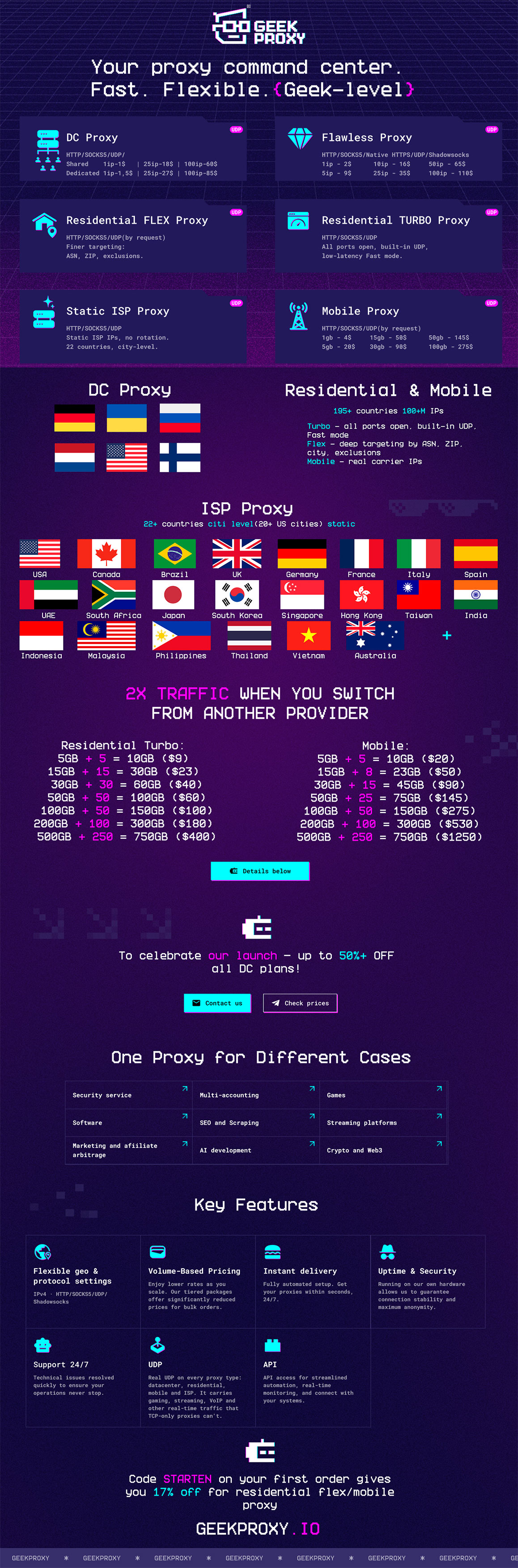
Hey Community!
GEEKPROXY - direct infrastructure provider (no reselling). Datacenter proxies (IPv4), residential and now mobile - all on one balance, plus a client API and free testing tools.
How to use: https://geekproxy.io/how-to-use
Early Adopter Privilege: to mark our release, a 50%+ discount on all datacenter proxy subscriptions. Strictly limited in time for our first partners!
2X TRAFFIC WHEN YOU SWITCH FROM ANOTHER PROVIDER: already paying another proxy provider for residential or mobile? Bring it to us. Show your active subscription and we double your traffic. Up to 50 GB residential and 5 GB mobile are doubled 1:1, larger packages get +50% on top. No proxies yet? Code STARTEN on your first order gives you 17% off. Details below.
1. PRIVATE IPv4 (DATACENTER)
Running on our own server hardware with powerful channels up to 5Gbps. A solid solution for traffic arbitrage, SMM and gaming.
Locations: USA, Germany, Netherlands, Russia, Ukraine, "Europe Mix" package. Check new countries at website (Can't find the one you need? We'll set it up on request!)
Protocols: HTTP(s), SOCKS5 and UDP (great for games and specific software).
Types: Shared and Dedicated IPv4. Billed per IP, unlimited bandwidth.
Instant delivery: proxies appear in your dashboard within 10 seconds after payment.
Pricing (Monthly):
Shared: 1 IP - $1 | 5 IP - $4.5 | 10 IP - $8.5 | 25 IP - $18 | 50 IP - $33 | 100 IP - $60
Dedicated: 1 IP - $1.5 | 5 IP - $7 | 10 IP - $12.5 | 25 IP - $27 | 50 IP - $50 | 100 IP - $85
Flawless proxy:
Adds extra protocols Shadowsocks and real HTTPS
1 IP - $2 | 5 IP - $9 | 10 IP - $16 | 25 IP - $35 | 50 IP - $65 | 100 IP - $110
Most providers advertise "HTTPS" but actually run HTTP-with-CONNECT: the client-to-proxy channel is plaintext and your destination leaks via SNI on the very first hop (readable by your ISP, Wi-Fi operator, corporate DPI, transit carriers). Our Flawless datacenter package gives you real HTTPS. The client-to-proxy channel itself is TLS 1.3 encrypted with a valid Let's Encrypt cert, zero header leaks. Full protocol writeup is on the website.
2. RESIDENTIAL PROXIES
A global pool of millions of crystal-clean IP addresses of real users worldwide. Every profile gets a flawless real-user fingerprint. Forget bans and easily bypass the strictest anti-fraud systems.
Targeting: free country selection. Need more precision? Filter down to state, city, ZIP code and ISP (ASN). With advanced filters traffic is consumed at a 2:1 ratio.
Smart sessions: dynamic auto-rotation on every request, or hold a Sticky session up to 120 minutes.
High capacity: up to 2000 concurrent threads per plan. HTTP(s) and SOCKS5 supported, UDP enabled on request (turned on in minutes via support).
Pricing (Monthly): 1GB - $3 | 5GB - $14 | 15GB - $39 | 30GB - $72 | 50GB - $110 | 100GB - $190 | 200GB - $340 | 500GB - $750
Documentation: https://geekproxy.io/doc/residential-proxy-tutorial
3. MOBILE PROXIES
Real mobile carrier IPs - the hardest type to ban. Coverage and targeting like residential: country, state, city, ZIP and ISP (ASN).
Smart sessions: auto-rotation or Sticky up to 120 minutes.
HTTP(s) and SOCKS5 supported, UDP enabled on request.
Pricing (Monthly): 1GB - $4 | 5GB - $20 | 15GB - $50 | 30GB - $90 | 50GB - $145 | 100GB - $275 | 200GB - $530 | 500GB - $1250
2X TRAFFIC WHEN YOU SWITCH FROM ANOTHER PROVIDER
Track 1, migrating from any provider. Record a short video of your current provider's dashboard showing: an active residential/mobile subscription, the proxy type, the package size and the last payment date (within 30 days). Send the video to our Telegram support with the package you want, pay, and we credit the bonus afterwards.
Residential: 5GB +5 = 10GB ($14) | 15GB +15 = 30GB ($39) | 30GB +30 = 60GB ($72) | 50GB +50 = 100GB ($110) | 100GB +50 = 150GB ($190) | 200GB +100 = 300GB ($340) | 500GB +250 = 750GB ($750)
Mobile: 1GB +1 = 2GB ($4) | 5GB +5 = 10GB ($20) | 15GB +8 = 23GB ($50) | 30GB +15 = 45GB ($90) | 50GB +25 = 75GB ($145) | 100GB +50 = 150GB ($275) | 200GB +100 = 300GB ($530) | 500GB +250 = 750GB ($1250)
Track 2, first purchase with us. Register, pick any residential/mobile package, enter code STARTEN at checkout and get 17% off.
Full details https://geekproxy.io/blog/promo-may-26
API FOR CLIENTS
Full API for automation: generate and manage proxy lists, top up and check balance, switch rotation and sticky sessions programmatically. Plug us straight into your scrapers, antidetect setups and farming tools.
Docs: https://geekproxy.io/api/docs#description/introduction
FREE TOOLS
Proxy checker: geekproxy.io/tools/proxy-checker
UDP checker: geekproxy.io/tools/udp-checker
GUIDES & CASES
https://geekproxy.io/cases
Payment: crypto and bank cards.
Best use cases: traffic arbitrage (FB, Google, TT), account farming, large-scale web scraping, SMM, gaming, YouTube, multi-accounting and WEB3 projects.
AFFILIATE & RESELLING PROGRAM: earn with us! Lifetime recurring payouts for referred clients:
Datacenter proxies (IPv4): up to 30% commission.
Residential proxies: flat 17% lifetime commission. Want to resell or partner? Message support for details and your referral link.
Fair Play refund policy:
Datacenter proxies (IPv4): 24-hour money-back guarantee on subscriptions. If the proxies don't fit your tasks - just let us know on the first day.
Residential & mobile: refund of the unused balance within the first 24 hours! The amount is calculated after deducting the cost of the traffic you've already used, and the final refund is rounded down to a whole number.
Balance: balance top-ups are final and non-refundable.
Our advice: unsure? Take the smallest package to test our network quality before ordering a serious volume.
FREE TEST FOR A REVIEW: we give away free datacenter proxy test packages to reputable forum members in exchange for an honest review! Reply "Interested" or "+" in this thread (or in the chat on the website) to grab your test.
Contacts:
Website: https://geekproxy.io/
Discord: geekproxy
Telegram: https://t.me/geekproxy_helpbot
Telegram news: https://t.me/geek_proxy
Geek bless your network!
#5
Search Engine Optimization SEO / Re: What is Google matrix?
Last post by SKPTitleLLC - September 09, 2026, 12:43:35 PMA Google matrix is a special mathematical table used by Google's PageRank algorithm to rank web pages.
#6
Search Engine Optimization SEO / Re: What is Domain Authority ?
Last post by SKPTitleLLC - September 09, 2026, 12:42:09 PMDomain Authority® (DA) is a search engine ranking score developed by Moz. It predicts how likely a website is to rank on search engine results pages (SERPs) compared to competitors. The score ranges from 1 to 100, with higher scores indicating a greater ability to rank.
#7
Search Engine Optimization SEO / Re: What are different types o...
Last post by SKPTitleLLC - September 09, 2026, 12:40:50 PMThe three main types of web links are internal links, external links (outbound), and backlinks (inbound).
#8
Search Engine Optimization SEO / Re: What is Micro Blogging?
Last post by SKPTitleLLC - September 09, 2026, 12:40:08 PMMicroblogging is the practice of publishing very short, concise posts—such as brief sentences, images, or links—on online and social media platforms.
#9
Search Engine Optimization SEO / Re: Which is better meta robot...
Last post by SKPTitleLLC - July 20, 2026, 12:07:29 PMNeither is "better" because they serve completely different purposes. Use meta robots tags to control whether a page appears in search results, and use robots.txt to control where search engine bots are allowed to crawl.
#10
Search Engine Optimization SEO / Re: how to improve google sear...
Last post by Lopeztoure - December 10, 2025, 04:44:41 AMImproving Google rankings isn't about hacks, it's mostly doing the basics really well. What helped me was looking up into a few things: making pages load faster, fixing titles/descriptions, answering the exact questions people search, and building a few real, relevant backlinks instead of chasing random ones.
And honestly, these weren't enough, so I reached out for professional help. A team like Tidal Digital walked me through what actually mattered, because I was wasting time on things that didn't move the needle anymore.
If you focus on clean site structure, helpful content, and a little expert guidance when needed, rankings start improving way faster than you'd expect.
And honestly, these weren't enough, so I reached out for professional help. A team like Tidal Digital walked me through what actually mattered, because I was wasting time on things that didn't move the needle anymore.
If you focus on clean site structure, helpful content, and a little expert guidance when needed, rankings start improving way faster than you'd expect.